Trauma Leaves Fingerprints in Ordinary Places
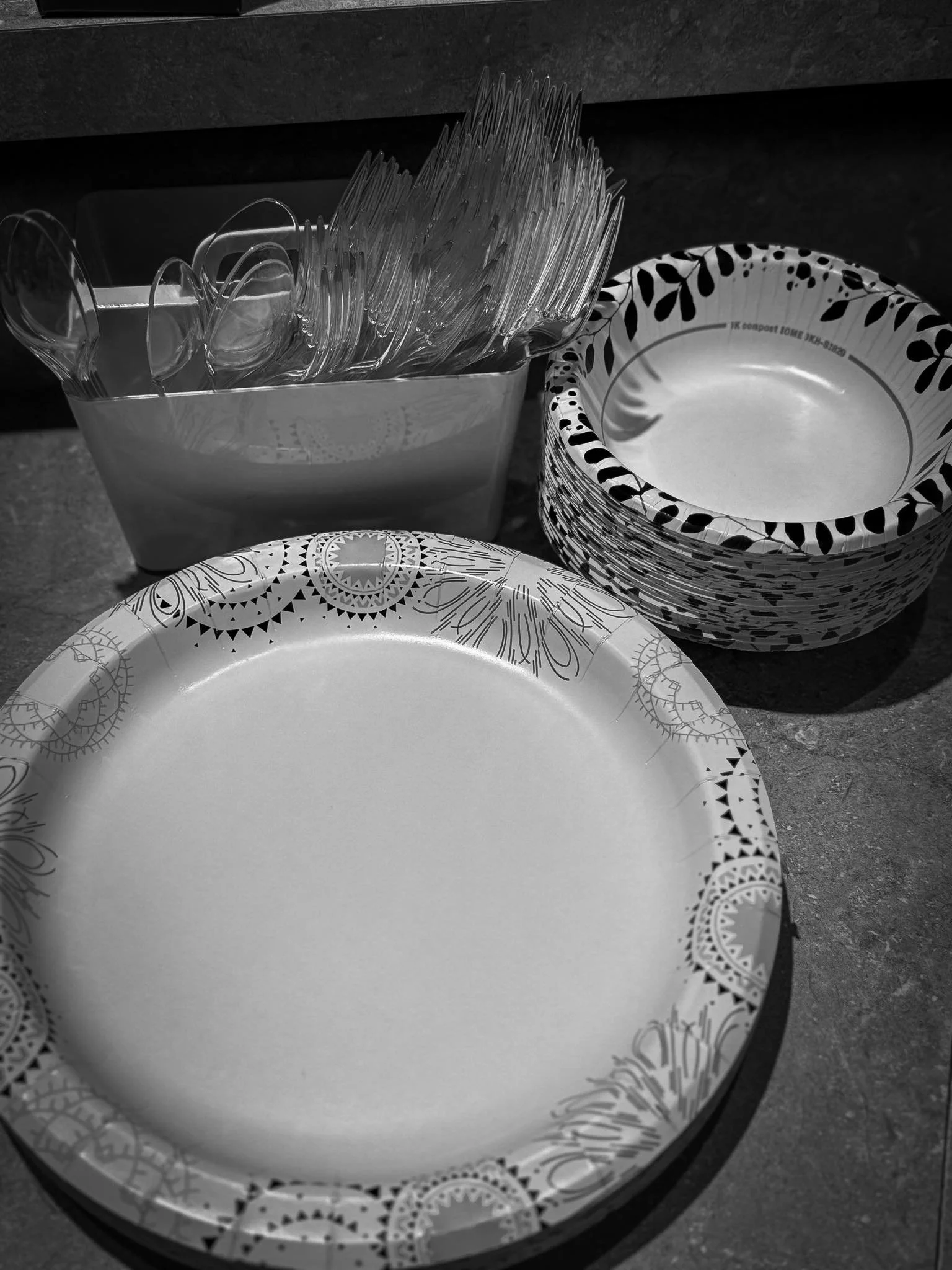
Paper plates.
Plastic forks.
Plastic spoons.
After more than a dozen mental health diagnoses since I was twelve - each one with its own stack of medications - this year I was finally diagnosed with CPTSD. And honestly, it has led to the first real healing I’ve ever known.
I’m learning to recognize emotional flashbacks and guide myself through them. And the more I do, the more it feels like a snowball rolling downhill. The numbness melts. Memories surface. I relive them fully and deeply, but now I can actually process them. I can see that I was just a little babe, and the adults around me were already broken.
And somehow, that’s how I ended up here today - standing in my kitchen, looking at paper plates, paper bowls, plastic spoons, plastic forks spread across the counter.
I’ve never owned a full set of dishes. I’ve looked. I’ve admired them. I’ve oohed and ahhhed over them. But I never buy them. I just don’t. I never questioned it. I always joked that we’ve always used them, and it drives James absolutely crazy. He hates the paper and plastic stuff.
What surprised me wasn’t the memory itself - it was how long I’d lived with the behavior without questioning it. I didn’t see it as fear or avoidance. It felt practical. Normal. Invisible. That’s the thing about trauma responses: they don’t always look dramatic. Sometimes they look like habits no one thinks twice about. But today, standing there in my kitchen, something shifted. My heart hurt. While I was driving the kids to school, pieces of a memory started sliding back in. When I got home, I let myself feel it.
Dishes.
Something so simple. Something most homes have without thinking. Something my dad loved to collect while “junking,” because he always found pretty glass plates and bowls. At night, he would wake us up and drag us into the living room. He would break whatever he grabbed. Glass and plastic everywhere. Shards scattered across the floor. He would make me and my sister clean it up while my mom stood there watching, crying softly. She never showed emotion, so seeing her cry felt wrong. Even as a child, it was unsettling.
And the snowball kept rolling.
I thought of our home. Of my sister being so little. Of wanting to protect her. Of kneeling on rice with our arms stretched out until we physically couldn’t anymore - and then being screamed at for whatever storm was inside him.
He was sick. He was drowning. His eyes would go black. Spit would fly from his mouth.
This wasn’t a once-in-a-while thing. This was most days he was home. And when he left for a few days, the peace felt unreal. Quiet. Soft. Safe. Then he’d come back happy again, and it would all start over. He could always find more dishes to break.
And so here I am, at thirty-three, standing in my kitchen wondering why I still don’t have pretty dishes, even though I left that home at eleven.
Trauma leaves fingerprints in places you don’t think to look. And sometimes it looks like a cabinet full of paper plates.
